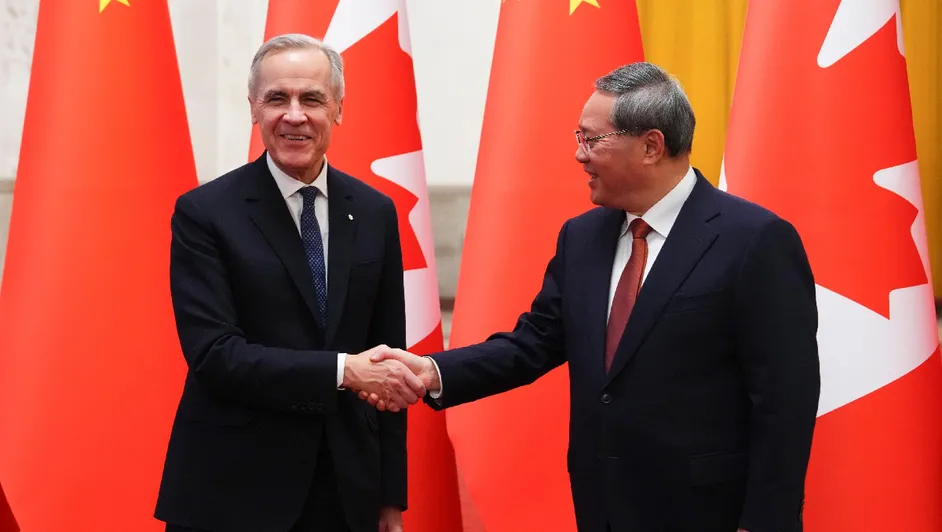
In the first visit by a Canadian prime minister to China in eight years, Prime Minister Mark Carney said on Thursday that Canada and China are entering a new phase in their bilateral relationship, as both countries seek to reset ties after a long period of political and trade tensions.
Carney, who took office ten months ago, is working to repair relations with Beijing following years of strain caused by diplomatic disputes, trade conflicts, and policies closely aligned with the United States.
Among the most sensitive issues were the 2018 arrest of Huawei CFO Meng Wanzhou in Canada at Washington’s request, as well as the 100% tariffs imposed on Chinese-made electric vehicles and 25% tariffs on steel and aluminum announced during former prime minister Justin Trudeau’s government.
High-level meetings signal a shift
During his visit, Carney met with Chinese Premier Li Qiang, who welcomed the change in tone and described the meeting as a positive step toward stabilizing relations. Carney is also scheduled to meet with Chinese President Xi Jinping, underscoring the political significance of the visit.
Canada’s Foreign Affairs Minister Anita Anand, who is accompanying Carney, said the prime minister aims to lay the groundwork for renewed dialogue across multiple areas, including trade, energy, and international cooperation.
Chinese Foreign Minister Wang Yi described the visit as a turning point that could open new opportunities for bilateral relations.
Trade pressures and dependence on the United States
The renewed engagement with China comes amid growing economic pressure from the United States. Recent tariff increases imposed by President Donald Trump on Canadian exports have intensified Ottawa’s efforts to diversify its trade relationships.
Currently, more than 75% of Canada’s exports go to the United States, a level of dependence Carney has pledged to reduce by doubling exports to other markets over the next decade.
China represents a critical alternative market. During the trip, Carney met with major Chinese companies, including Alibaba, state-owned energy giant China National Petroleum Corp., and CATL, one of the world’s largest manufacturers of electric vehicle batteries.
A recent past marked by retaliation
Relations deteriorated sharply after Meng Wanzhou’s arrest, when China responded by detaining two Canadian citizens on espionage charges, a move that severely damaged diplomatic ties for more than two years.
Beijing later imposed retaliatory tariffs on Canadian agricultural exports such as canola, pork, and seafood—measures that effectively shut Canada out of the Chinese canola market, according to industry groups.
Canada’s strategic recalibration
In a post on X after arriving in Beijing, Carney stated:
“We are ready to build a new partnership—one that draws on the best of our past and responds to today’s challenges.”
China, for its part, hopes that U.S. trade pressure will push Canada and other allies toward a more independent foreign policy, reducing reliance on Washington.
Why this matters
This diplomatic shift is more than symbolic. For Canada, rebuilding relations with China is a strategic necessity, with implications for trade, economic stability, and geopolitical autonomy.
For those living in Canada—or planning to move there—these developments may affect:
- employment
- trade and industry
- cost of living
- long-term economic stability