The diplomatic dispute between the United States and Europe over the future of Greenland escalated this week during the World Economic Forum in Davos, where the European Union warned that it would respond in a “firm, united, and proportional” manner to pressure from U.S. President Donald Trump, while Washington urged Brussels to exercise restraint and avoid retaliation.
Trump reiterated his interest in acquiring the Arctic island—an autonomous territory under Danish sovereignty—and, when asked about the limits of his stance, simply replied, “You’ll see.” Despite recent polls indicating that most of Greenland’s population opposes joining the United States, the president claimed that once they understand his proposal, “they will be delighted.”
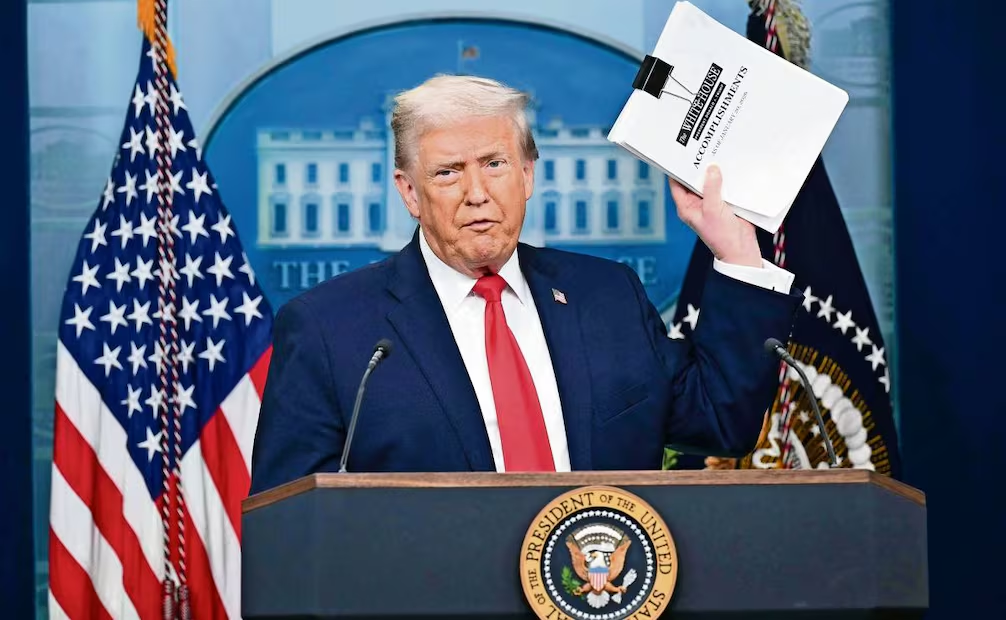
The U.S. president downplayed European warnings about possible trade countermeasures, after EU leaders floated the suspension of the EU–U.S. trade agreement or the activation of the anti-coercion mechanism, known as the “trade bazooka.”
“They want that agreement. They need it. I doubt they’ll break it, but we’ll see what happens,” he said.
From Davos, Trump stated that he is holding key meetings on Greenland and claimed that any eventual deal would benefit NATO. However, he ruled out attending the extraordinary G7 summit in Paris convened by French President Emmanuel Macron.
The political atmosphere in Davos was largely critical of Washington. Canadian Prime Minister Mark Carney said that the “old world order” has come to an end and warned that “obedience does not guarantee security,” while expressing his support for Greenland and Denmark.
In the same vein, Macron urged the European Union not to hesitate to use its trade tools when international rules are not respected.
“We prefer respect to intimidation,” he said.
Meanwhile, U.S. Trade Representative Jamieson Greer warned that resorting to the European anti-coercion mechanism “would not be prudent,” as it includes measures such as restrictions on imports, exports, and investments.
At the same time, the European Parliament decided to suspend the ratification of the trade agreement reached in 2025, which set U.S. tariffs of 15% on most European exports without an immediate response from the EU.
European Commission President Ursula von der Leyen warned that Washington’s strategy could seriously damage the transatlantic relationship.
“The proposed tariffs are a mistake between historic allies. Our response will be firm, united, and proportional,” she concluded.